

What's real
Anxious thoughts, reality/unreality, and the moon

There was a stretch of time this summer—a month or so long—during which the baby stopped sleeping. It wasn’t quite that dramatic, but it felt close. She hit the eighteen-month sleep regression early and suddenly required elaborate singing-rocking-patting-shushing rituals to fall asleep, and then even more elaborate rituals to fall back asleep when she woke during the night. Most nights she was up multiple times, sometimes for an hour and sometimes for three. She wanted to be held and rocked into oblivion. She wanted us to lay her down, millimeter by millimeter, in a descent so gradual that she didn’t realize she was being transferred from arms to crib. Once back in her crib, she wanted to be shushed and patted without pause or variation. When her breathing deepened, she wanted us to creep away without the floor creaking or a knee cracking, lest she wake and the whole process begin again.
During one of these nocturnal shifts I realized that the repetitive motions of soothing her to sleep felt a lot like the state of my mind. For months I’d been playing the same worries on loop, tracing and retracing thought patterns. There had been an upswing in my anxiety levels, causing my mind to contract and circle itself like a dog chasing its tail. I’ll never know why my anxiety flares up in some seasons and mellows to a muted hum in others. This year I’ve blamed its return on hormonal imbalances, weaning, and my body still regulating after the upheaval of postpartum—but really, anxiety’s ebbs and flows are a mystery.
I held the baby and counted to one hundred three times, waiting for her limbs to go limp in my arms. The room was so dark I couldn’t see whether her eyes were open or not. My legs ached, my left arm was nearly asleep, and dawn was only a couple hours away. But at least while holding her I was firmly planted in my real life. At least I was in my body instead of inhabiting the unreality of an anxious mind.
These days I am thinking a lot about what is real.
In Lit, her memoir about coming to sobriety and Catholicism (kicking and screaming on both accounts), Mary Karr recounts a conversation she had with her AA sponsor. “Before I judge somebody or indulge a groundless fear, Joan says I’m supposed to ask myself: What is your source of information? If the answer is—as it usually is—I thought it up, I should dismiss the idea.”
What is your source of information? Anxiety is not based in reality. It’s based in what-ifs. “The worry is just a thought” is something I tell my anxious brain often. Meaning, the worry is not a true thing; it is a thought about what might happen, what should have happened, what didn’t happen, etc. When it comes to catastrophic thinking and worst-case imaginings, it’s helpful to ask: What is the source of your information? More often than not, yes: I thought it up.
The Substack algorithm delivered this quote from Tommy Dixon to me recently and I’ve been mulling it over since:
Setting aside my usual resistance to binary language, this feels instinctively true to me. Anxiety is one thing that abstracts me from the physical world, but it’s far from the only thing. I’m always looking for a way out of my real life. I don’t think I’m alone in this. The smartphone, the productivity, the overconsumption, the magical thinking, the mindless entertainment—there are so many ways to escape our real lives.
Lately I have been trying to name what is real versus what is not. This means noticing when I’m withdrawing from reality and the immediate moment, whether through anxious thoughts or my phone or attacking a task list. I have been trying to discern what’s real—is this an intrusive thought, or is this something real that I need to attend to? —and once I do, to commit myself to being fully present to what is real.
If there is a Reality—which I believe there is, and which I call God—beneath what is purely material and comprehensible to our senses, then it follows that tuning ourselves to this Reality requires also tuning ourselves to the immediate life we have here, this minute. And it follows, too, that anything that sends us deeper into Reality is worth attending to and worth pursuing.
It’s not that real life is blissful to inhabit at every moment. Most days are a mixture of experiences: dentist appointments and lunch in the sun with a podcast and holding someone’s hand and random ripples of irritation, loneliness, grief. There are many hours which I would like to escape altogether: hours of boredom or self-abandonment or being woken up at 1 a.m. by a toddler projectile vomiting in bed. But then again, this is my life. This is my reality, and my one chance to move deeper into a larger Reality. The sick toddler, the barf bucket next to her, the baby nodding her head along to music, the morning sun splashed across the floor.
What’s real? This.
The essay that I quoted earlier circles this question: Does writing remove you from your life? It’s a good question.
I am writing on a book (!), which I will say more about soon. This means I’ve started waking up early twice a week and working on the manuscript before the work day begins. I sneak from my bedroom to the office, close the door, light a candle. The girls wake up and I hear Davis corralling them toward breakfast in the kitchen. Suddenly the baby’s hands are slapping the other side of my closed door with a “Hiiii Mama! Hiiiii!” Then her fingers slide beneath the door, searching for me through the half-inch gap. It makes me smile but I don’t open the door. Soon Davis scoops her up and returns her to her high chair.
I don’t worry that I should have opened the door, just like I don’t think Davis should hang up the phone during a work call because the girls are screeching “DADA” in the next room. But I can see the risk and the fear the essay pointed toward. Of course you can make art and parent children, and of course caregiver artists face unique obstacles to continuing their work.1 This season of parenting small children does not, on the surface, coexist well with writing, dependent as writing is on solitude, swaths of time to think, and many quiet hours. But my experience on a whole is that writing reorients and plants me back into what’s real. At its best, at least, writing doesn’t detach me from reality. I have to look closely at my life before I have anything to say. Before I can write I first need to live, intensely and attentively.
But take writing out of it: this is the way I want to live, period.
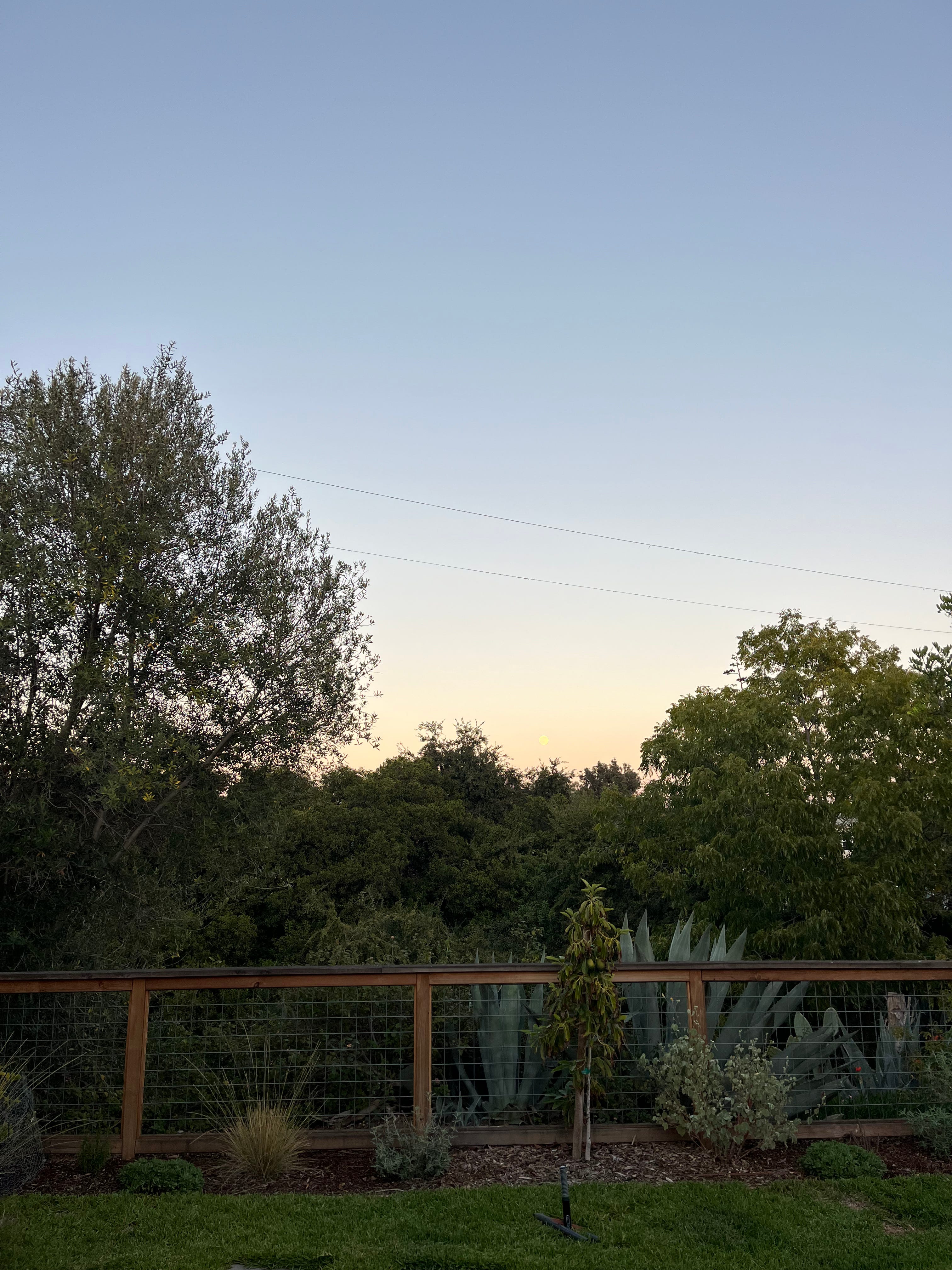
This evening we go for a walk. It’s 4:50pm; the moon is already huge and full and rising. The toddler gasps and lifts her hand as though to touch it. “It’s a whole moon!”
This is it; this is what’s real. Not the anxious thoughts or my spinning future plans or the distractions that whisk me from my body—but my actual life. The friends sprawled on our couch on a weeknight. The tending to small, sick bodies. The muffins, the voice texts, the phone conversations with my mom on a walk. The pecan tree leaves turning gold. The words typed while the sky is still dark. The closed door and the hands smacking it gleefully. The morning run with the dog through the canyon. The whole moon.
Read with me:
If you’re interested in theology and the maternal experience, I highly recommend Chine McDonald’s Unmaking Mary: Shattering the Myth of Perfect Motherhood. McDonald weaves personal narrative with theological and social commentary, unpacking how the idealization of Mary harms women and mothers. It’s fascinating and intimate and I’ve been underlining it excessively as I read (sign of a good book, imo).
Recent writing:
I reviewed martha park’s luminous essay collection World Without End for the Christian Century. Here’s a snippet:
From one vantage point, the book reads as a collection of eulogies, mourning Park’s place in a pew at her father’s church alongside losses in our natural world. But World Without End is not only about endings. As the subtitle suggests, it’s also about what comes after. After the extinction, after the birth, after the shift in faith—after all of these apocalypses—what then?
to whole moons and our real lives,
Annie
See Catherine Ricketts’ brilliant book, The Mother Artist.
This is so stunningly observed. The way you name the difference between what’s real and what pulls us away from ourselves... oof!
Wowowow! There was so much that spoke to me 🥹and I absolutely loved looking for the moon in that photo. Taking note of the book recommendation.