

Early summer dispatch
three books, mocktails, and notes from being away

Last week I wrapped up a ten-day writing residency at the Collegeville Institute in Minnesota. Ten days of walks on wooded trails and meals with other writers and one-on-one meetings about my manuscript. I worked at a desk overlooking the lake with a beeswax candle lit, looking out at big sky and big clouds.
The hospitality at Collegeville is so thorough and thoughtful, from the art in our apartments to the individually-portioned bags of locally roasted coffee. The staff prepared our meals, cleaned up said meals, and provided snacks and coffee and tea and printing services and shelves of books (THE LUXURY). In short, everything we needed to focus on our writing projects. The support allowed me to write and edit for hours on end, to deep-dive into the manuscript and tackle big-picture problems. It felt so damn good to sink my teeth in and gain purchase in a way I can’t when writing in two-hour chunks of time at home. The residency helped me start the essential work of weaving individual chapters into a cohesive whole.
Early summer in central Minnesota meant a gauzy sky and heavy air filled with dragonflies. Blue herons flew low over the lake to fish. Afternoon thunderstorms would crash over us for an hour or two before breaking up into mountainous clouds. Stepping out of my apartment, I’d notice the damp, piney scent. And so much green! (Says the California girl, starved for green in this drought landscape.) It was a fresh, new green, everything just starting to leaf out in colors like peridot and soft yellow and deep, saturated emerald.


The landscape made me think of the “greening power” or “viriditas” that the mystic Hildegard of Bingen wrote about: “There is a power that has been since all eternity, and that force and potentiality is green!” And this: “The Word is living, being, spirit, all verdant greening, all creativity. This Word manifests itself in every creature.” Hildegard imagined viriditas as the greening power of our environment, the greening power of creativity, and the greening power of the Spirit working through us.
I carried back a lot of gratitude for this time away—all that space and expansion, all that greening!—along with three thoughts on writing and making art. Adopt, repurpose, and use them for yourself:
Making art hinges on availability. Before you begin, make yourself available to what the work wants to say. Availability requires silence, space, listening, and curiosity. Going for walks. Absorbing art in other mediums. Taking a shower, making a snack. Possibly many activities that look nothing like the work itself, but that are still essential for creating a posture of receptivity. This reminder comes from artist Kim Smolik, who gave an artist talk to our group. “Slow down regularly to hear what is already present,” she said. Practice stepping away every 20-30 minutes from whatever you’re working on. Listen to the work and it will teach you.
Trust the particularity of your voice. Be exactly your idiosyncratic self. People will find out who you are anyway; don’t disguise it. As readers, we are drawn to the particularity of a writer’s voice and style. This is a superpower. Your enthusiasm is catching. Don’t water anything down.
Rewrite to revivify language. When you re-read your work and come across a paragraph that falls flat or loses heat, put the work aside. Then, rewrite the paragraph from memory (and even better, by hand). Notice how your voice reappears in the new paragraph, and revise from there. (Thank you to our workshop leader Michael McGregor for this advice.)
I’ve chased writing as a career for ten years, and for much much longer as my unpaid labor of love. This residency was one of the first times I experienced robust financial and institutional support for artists. Our culture may talk about valuing art and beauty, but there’s no money in it and extremely limited structural backing. Collegeville Institute is one of the rare places that offers this kind of belief, backed by practical support.
You know what you should do this summer? Apply for a Collegeville workshop. I’m telling all my writer/artist/ministry friends: apply! Did I mention it’s fully-funded? Lodging, food, airfare, travel costs, EVERYTHING. They’ll be announcing new workshops for 2027 soon, so check back often.
Summer drinking
Besides apply for a Collegeville workshop, do you know what else you should do this summer? Master a mocktail. Here are two that I’m making on repeat these days.
For hydration: The first is a twist on the Mexican suero—a hangover cure made with Topo Chico and fresh lime juice and salt. The version I make includes coconut water: just mix equal parts coconut water and mineral water with fresh lime juice to taste (but, you know, go big—the more the better). Run a wedge of lime around the rim of the glass and roll it in sea salt.
Kinda like a Negroni: When I made negronis for everyone else and this mocktail for myself, my brother-in-law requested the NA version as his refill. It really is that good. If you come over to my house this summer I will make you one/force on upon you. For this, you have to buy the Italian bitter soda called Sanbitter as a Campari substitute. You could serve it as-is over ice with an orange wedge, but my version is 3 parts Sanbitter to 1 part grapefruit juice, topped with a splash of mineral water and angostora bitters. Plus that orange wedge.
Three books shaping my own
There are dozens of books shaping my own. These are books I’ve been in conversation with for months and years, books that have kept me company since my own first matrescence. The suitcase I brought to Minnesota barely avoided an overweight luggage fee, and that’s because books took up a full half of the bag. Here are three that I packed:
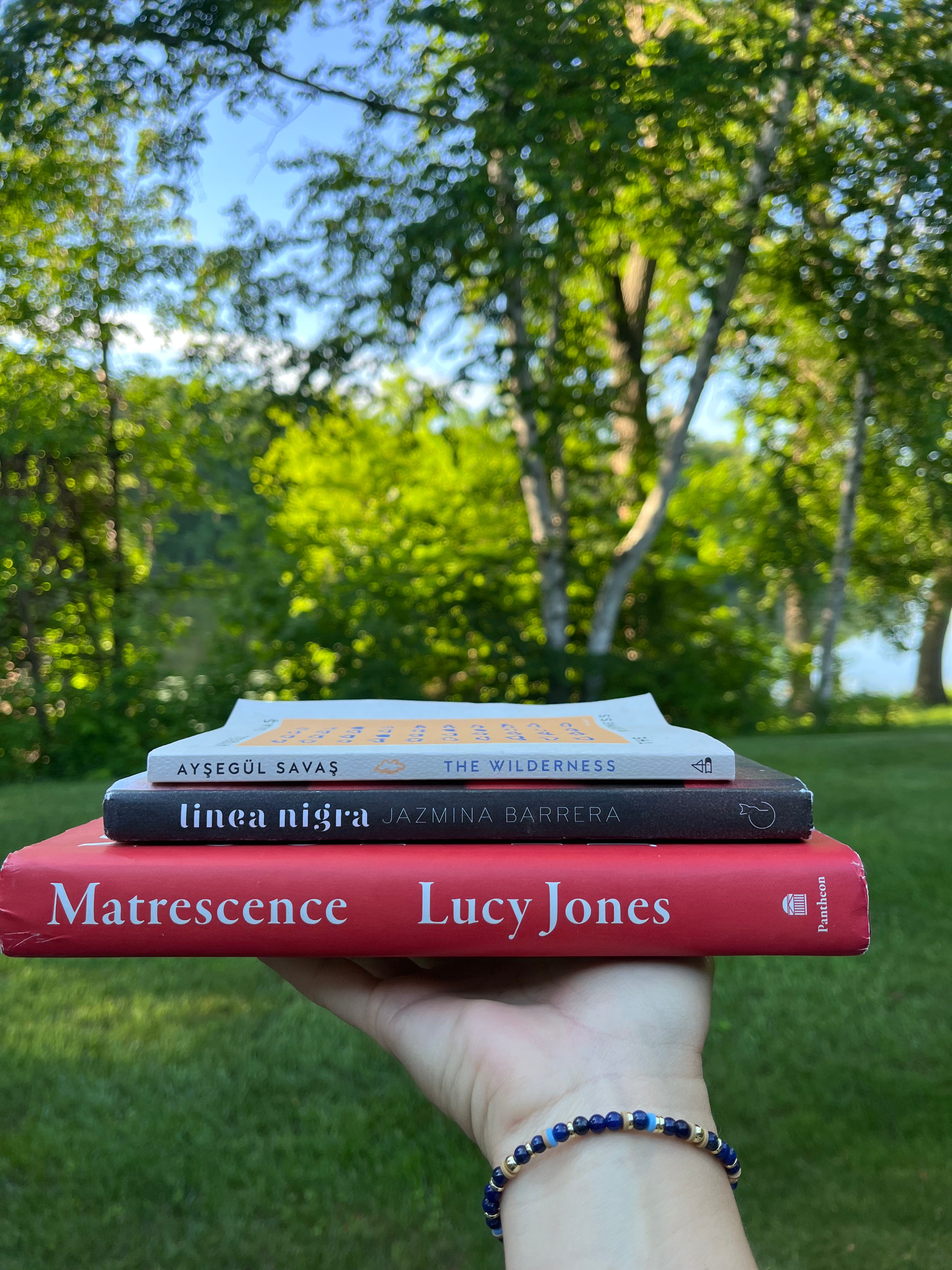
The Wilderness by Ayşegül Savaş - An exploration of cultural mythology and lore surrounding the first forty days postpartum, plus fragmented first-person vignettes about those bewildering, destabilizing days. The book is structured in forty short sections, which gives The Wilderness a diaristic quality. Very visceral and immediate.
“What interests me, in the extreme embodiment of the postpartum, is the swarm of encounters during this time: with the baby, more animal than human, more sensory than intellect, and with the invisible presences that flock to the site of birth, of new life. I find, in this liminal existence, a site for multiplicity, for experiencing the world beyond ourselves.”
Linea Nigra by Jazmina Barrera - Probably the book I recommend the most to pregnant and postpartum friends. Another book in fragments (perfect for breastfeeding reading!). Linea Nigra is the book that first gave me an imagination for how to write through the disjointed months of infancy: in fragments, snatched whenever you can. It’s intimate and smart; Barrera shifts back and forth between studying her own experience to studying visual art and literature about the maternal experience. It reads like a commonplace book curated by an artist, which I love.
“Breastfeeding is an act of faith. We don’t see the milk the way we would water in a glass. We, the mothers, see the residue on the mouth of our children; we sometimes watch them devour it, but we never know how much they are drinking. In a brilliant essay, Margarita García Robayo says that breasts should be transparent.”
Matrescence by Lucy Jones - A dense, heady book diving into the science of pregnancy, birth, and postpartum. It’s also deeply beautiful. Jones is a phenomenal writer, and I love that each section begins with a prelude about an organism or a landscape (e.g. tadpoles, volcanoes, the moon). Matrescence goes deep into research about the transformations of early motherhood, a time that scientists have only recently acknowledged is as dramatic as the changes humans undergo in adolescence. This book captures the seismic nature of motherhood’s inner and outer conversions, as well as their social and political implications.
“I thought early motherhood would be gentle, beatific, pacific, tranquil: bathed in a soft light. But actually it was hard-core, edgy, gnarly. It wasn’t pale pink; it was brown of shit and red of blood.”
What are you reading this summer? What are you drinking? What’s inspiring you and making you more available to the work? Let me know, let’s chat!
ICYMI
A recent post on pregnancy brain and coherence/incoherence:

Thanks for reading with me—I’m so glad you’re here.
If you enjoyed this post, here are three ways you can support this self-employed writer working on her first book(!):
Subscribe to Read With Me, or upgrade to become a paid subscriber (thank you, thank you).
Like, comment, or forward this to a friend. If you have your own Substack, consider recommending Read With Me using the recommendations feature. Word of mouth is the best way for readers to discover new work.
I offer one-on-one coaching and editing. If you’re stuck on a draft, curious about building a freelance career, or need advice on publishing your writing, I’d love to hear from you.
I’m in a car diving to Collegeville as I read this lovely post! Ready for the greens of June
So good to see those glimpses of you in MN — and hear a bit about the time and writing here. Huge huzzah for Collegeville Institute! And for you and all your words, friend.